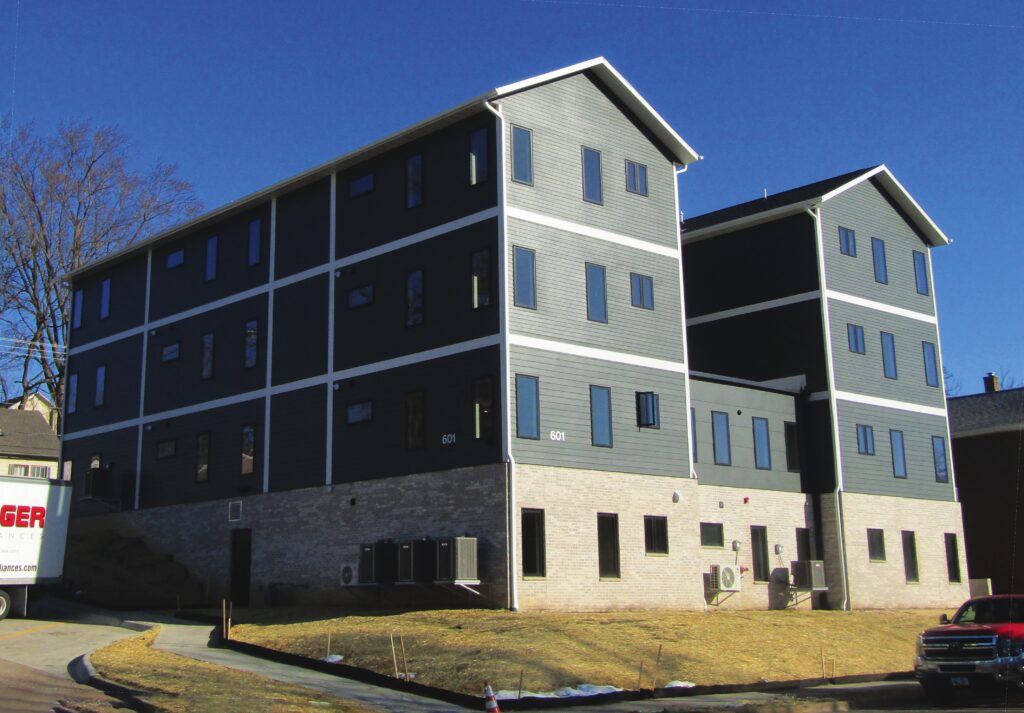
Adam Meuser toured the new $3.8 million Ries Harbor Apartments complex in Muscatine on Thursday, March 18.
He viewed some of the 21 apartments and many other features of the approximately 16,000-square-foot building that will soon be home to low-income and homeless residents. He liked everything he saw.
“It’s really nice here. This is going to be a great asset for our community,” said Mr. Meuser, director of business development for Community Health Care, Inc. in Muscatine.
Mr. Meuser was one of about 100 people who helped welcome Ries Harbor Apartments, 601 E. Sixth St., during a grand opening and ribbon-cutting ceremony.
The three-story building is a Muscatine Center for Social Action (MCSA) project. The complex aims to house homeless, chronically homeless and extremely low-income residents of Muscatine County. The building was designed by Horizon Architecture of Iowa City and constructed by Todd Hackett Construction of Muscatine.
Residents will pay rent based on a portion of their income. The 21 one-bedroom apartments — six of which are ADA compliant — are expected to begin filling in early April, with full occupancy anticipated by mid-May, said Jason Dornbush, MCSA project manager.
Mr. Dornbush noted that despite the March 18 grand opening, the complex remains a work in progress. Minutes before the ceremony began, workers delivered appliances for some units. A few more punch-list items also remain. The apartments will be fully furnished, thanks to donations from local businesses and residents.
“The community has been very generous in donating furnishings,” he said.
Guests had the opportunity to tour the apartments, front lobby and offices. Beyond housing, the building will feature on-site staff present 24 hours a day as well as case workers.
Tenant selection will utilize the Coordinated Entry System to receive referrals and identify eligible participants. MCSA uses the Vulnerability Index-Service Prioritization Decision Assessment Tool (VI-SPDAT) to prioritize households experiencing homelessness and in need of supportive housing, with an emphasis on those with the greatest need.
The ceremony also served as an occasion to thank the community for its support. MCSA leaders recognized the many partners who helped make the project possible, including the Iowa Finance Authority, the National Housing Trust Fund, Iowa Economic Development, Iowa Title Guaranty, the Roy J. Carver Charitable Trust, Watersmith Engineering, Axiom Consultants, UnityPoint Health Trinity Muscatine, the City of Muscatine, the Muscatine Police Department and UnityPoint Health Robert Young Center.
“This is a shining example of how Muscatine does things differently and boldly to help others,” said Naomi DeWinter, president of Muscatine Community College and an MCSA board member.
Ms. DeWinter also praised the project’s namesake, Sister Irma Ries, a member of the Sisters of the Presentation and one of MCSA’s original executive directors. Sister Ries, who is retired and living at the Sisters of the Presentation of the Blessed Virgin Mary facility in Dubuque, Iowa, was unable to attend due to health. Several members of the Sisters of the Presentation attended the ceremony.
“Sister Irma Ries called us to serve others with reverence and compassion. Her words continue to shape the mission and actions of Muscatine Center for Social Action today. Naming this development Ries Harbor Apartments honors her legacy of care and reinforces our commitment to creating a safe harbor where individuals experiencing homelessness can find stability, dignity and hope,” Ms. DeWinter said.
Following the ribbon cutting, attendees had the opportunity to tour the new apartments. Among them was Sister Joetta Venneman of the Sisters of the Presentation. After viewing Apartment 16, she said Sister Ries would have loved the building.
“She would say this is a dream come true. And she would also say ‘What took so long to get this done?’” Sr. Venneman said with a laugh.
MCSA is also working on other housing initiatives, constructing new homes to be sold to first-time homebuyers, with preference for elementary school teachers or families that currently rent. Those projects are funded through an IFA HOME Grant and are exploring construction efficiencies, including use of a WikiHouse modular roof system designed for durability and climate resilience.