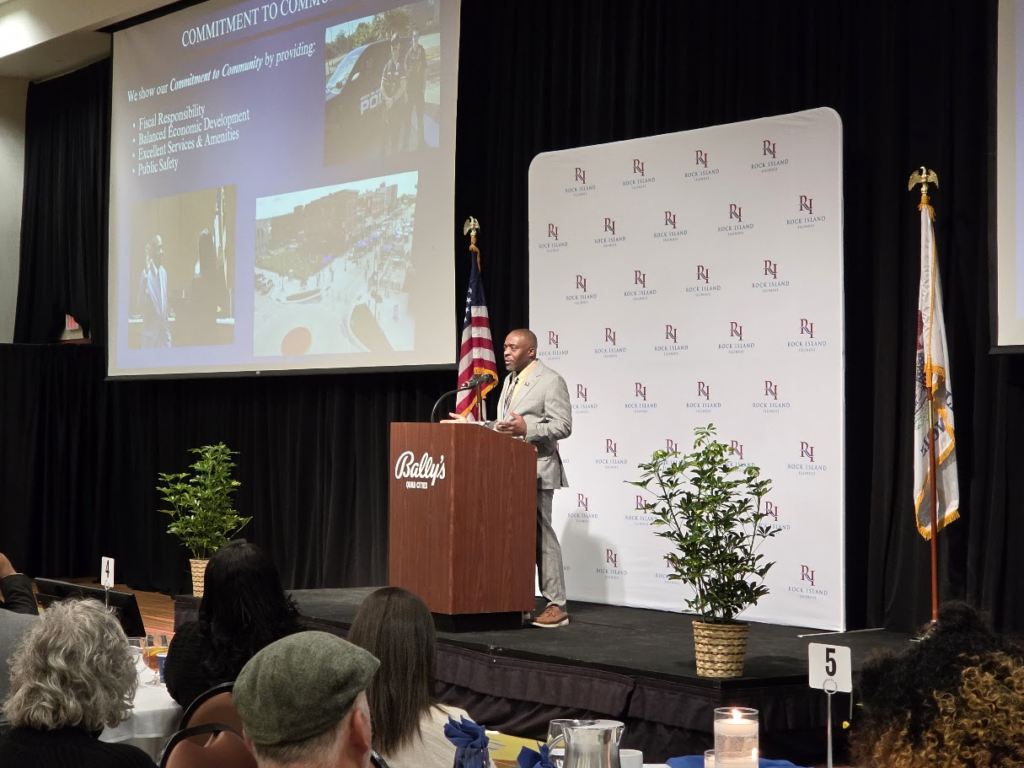
Mayor Ashley Harris delivered a Rock Island State of the City address on Thursday, Jan. 29, at Bally’s Casino & Hotel that focused more on what he believes the city still needs to do than what it has accomplished.
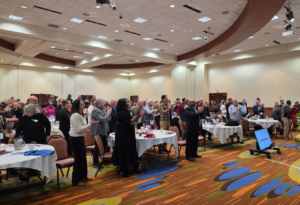
In fact, the mayor, who was elected last April and took office on May 12, laid out before a large crowd of leaders and city staff an ambitious vision for an inclusive Rock Island that is focused on growing the city’s population, creating jobs and investing in both its existing business and all its residents including those who are unhoused.
Mr. Harris said Rock Island faces serious challenges. Among them are a stagnant population, high property taxes, aging infrastructure and a poverty rate of 1 in 5 residents. That’s more than any other city in the region, he said. (With an assist from dphilms, his address is available on the city’s YouTube page.)
The mayor committed Thursday to tackling such issues directly through fiscal responsibility with a renewed standard of customer service and transparency at city hall. “If you work for Rock Island, you should believe in Rock Islanders – all of them – regardless of income, housing status, or background,” he said.
Rather than chasing a single “silver bullet” project, Mr. Harris outlined an economic development approach that he said invests heavily in the city’s strength. That includes by supporting existing businesses, leveraging anchor institutions such as Augustana College and the Rock Island Milan School District, and making it easier for entrepreneurs to work with the city.
Creating career pipelines
A key pillar of the mayor’s vision is investing in people and he called for stronger pipelines between schools, unions, employers, and higher education to keep talent in Rock Island; the strategic use of tools like Community Development Block Grants to help residents build savings and move toward education and homeownership; and housing accountability.
The city, he said, will pursue policies that discourage speculative ownership of vacant properties, hold landlords to basic standards of safety and health, and treat homelessness and poverty as conditions to be reduced, not reasons to push people out of town. He also emphasized the need for a regional approach to housing and services, working collaboratively with neighboring communities.
Mr. Harris also saluted the city’s major employers and economic drivers in such industries as health care, insurance and construction along with a wealth of unique small businesses that keep investing in the city even as others have left.
And he celebrated a community rich in culture and food that boasts a vibrant arts scene, great parks, events, festivals and celebrations. The city also is grounded by effective and active nonprofits and community and friends-of groups, he said.
“This place, Rock Island, is a city of people who stayed,” the mayor said.
On their behalf, he added, Rock Island must overcome such challenges as underfunded police and fire pensions, outstanding bond obligations, bad roads, the need for more housing and amenities and greater economic opportunity.
That requires resizing and restructuring the government to meet realistic revenues. That’s especially true with the expiration of the pandemic-driven American Rescue Plan Act (ARPA). That will mean he said, there is little room for “extra” spending.
People, not buildings
Mr. Harris also stressed that the city should invest in people, not just buildings. ”You can’t have a thriving downtown or corridors if residents aren’t economically, physically, and spiritually healthy,” he said.
Making that happen includes taking action against property owners who sit on empty buildings and holds landlords accountable for safe, healthy living conditions.
He also stressed “being unhoused or poor is not a moral failure” and referenced an emergency winter shelter at Project NOW in downtown Rock Island that had been closed by the City of Rock Island. It was relocated and reopened at 8 p.m., Wednesday, Jan. 21, in the BridgePointe 485 building on Moline’s riverfront.
“The solution is not to make poor people leave,” he said it is to make oupward mobility is possible. “I’m committed to it, supporting our small businesses and downtown residents to manage challenges that come with the unhoused population,” the mayor said,
He also stressed that the region’s housing shortage and homelessness challenges require a regional approach. That means cooperation across nearby cities and with nonprofits.
“I want Rock Island to be a place where people can come when they need affordability, to be loved, encouraged and supported in upward mobility,” Mr. Harris added.
He added that the best economic development strategy for Rock Island is to grow what’s already there by “treating existing businesses as the foundation, not the background noise.”
That means employing such existing tools as enterprise zones, River’s Edge, historic tax credits, tax increment financing (TIF) and similar programs. It also calls for building a talent pipeline for the city which is home to 10 Quad Cities labor union headquarters.
A ‘Magnificent 10’
To help harness that local energy and new ideas, Mayor Harris announced the creation of a new “Magnificent 10” task force. That group of Rock Islanders will be chosen not for their résumés but for their time, passion, and commitment to the city.
That volunteer body will help drive economic development efforts, connect with potential partners, and serve as visible ambassadors for Rock Island, backed by the full support of the mayor’s office.
The mayor also outlined a long-term concept for a “Purple Unit” within the police department: a dedicated, community-facing team focused on service and trust-building, to be launched when staffing levels allow.
“Rock Island has been part of every chapter of American history,” Mr. Harris said. “We will be at the forefront again – if we stay committed to Rock Island, and even more importantly, if we stay committed to one another.”