Deere’s success and the Quad Cities’ success aren’t the same thing, but they’re close enough to matter.
That’s why the company’s recent earnings report is welcome news.
The Quad Cities’ largest employer reported Feb. 19 a year-over-year revenue increase of 12.9% for the first quarter of 2026. The Moline-based Fortune 100 company’s gains were fueled by increased customer demand in small agriculture and construction machinery, Deere & Co. Chairman and CEO John C. May said in the earnings release.
Mr. May also said the company raised its full-year 2026 profit forecast to between $4.5 billion and $5.0 billion, despite continuing tariff challenges and persistently weak demand for large agriculture equipment.
Those improved earnings are translating into returning jobs and renewed life for a deflated manufacturing sector.
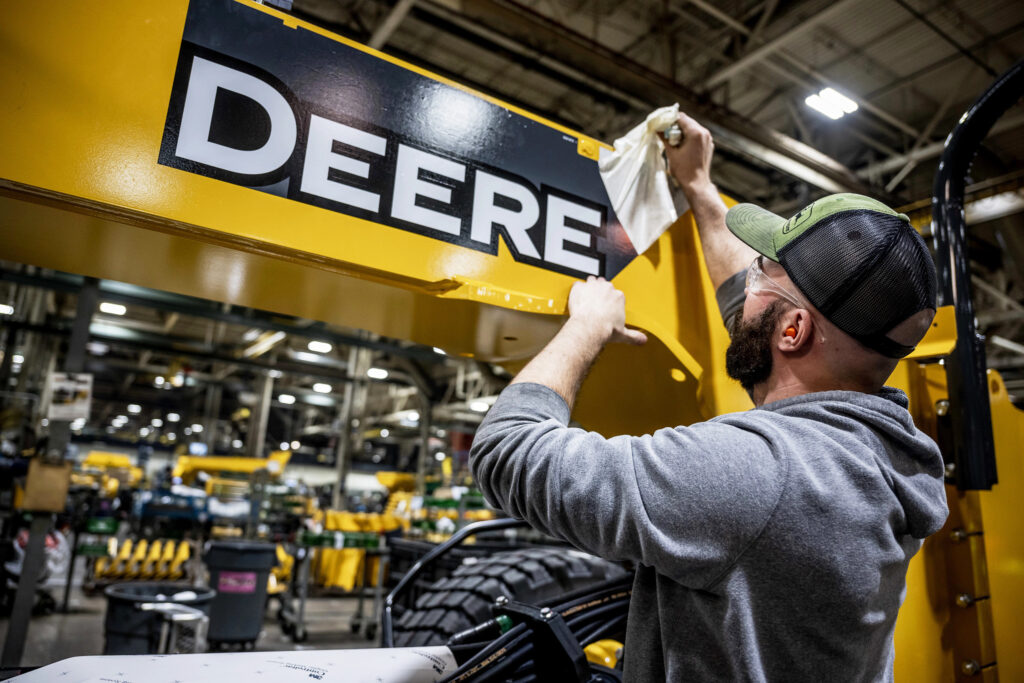
According to the company, John Deere is bringing 99 team members back to work at its eastern Iowa construction and forestry facilities. Callbacks began in mid-February.
Davenport Works is bringing back 75 workers. Dubuque Works is bringing back 25 workers.
As we wrote in this space in July 2024, the only silver lining to those previous layoffs was that Deere was making the adjustments necessary to keep the company financially healthy.
“While the global large agriculture industry continues to experience challenges, we’re encouraged by the ongoing recovery in demand within both the construction and small agriculture segments,” Mr. May said.
The company’s solid quarterly earnings and Mr. May’s comments also reinforce the well-documented cyclical nature of the farm economy. Agriculture operates on a seven- to 10-year boom-and-bust cycle, in which periods of strong demand and high profitability give way to downturns marked by low commodity prices that often fall below production costs. Weather patterns, global trade shifts – particularly around tariffs – and production lags all feed that volatility.
“These positive developments reinforce our belief that 2026 represents the bottom of the current cycle and provides us with a strong foundation for accelerated growth going forward,” Mr. May said.
Still, the road back is long. More than 3,500 Deere employees were laid off between October 2023 and September 2025, with heavy job losses in Iowa — Waterloo, Davenport and Dubuque — and Illinois, including Moline and East Moline, according to Investigate Midwest.
The workers returning are an encouraging sign, not a recovery.
A cautionary note comes from Creighton University economist Ernie Goss, whose monthly Rural Mainstreet Index released on Feb. 19 signals that the farm economy remains under serious stress.
The farm equipment sales component sank to a deeply weak 16.7, down from 18.8 in January. “This is the 30th straight month that the index has fallen below growth neutral,” Mr. Goss noted. “Lower interest rates and the $12 billion of federal farm support have yet to stimulate farm equipment sales.”
It’s too early to declare, but Deere appears to have leveraged its non-heavy agriculture divisions well and the overall cyclical agricultural downturn with financial discipline. For the Quad Cities, and for the broader agricultural and manufacturing economy, that is genuinely good news.