As global financial experts share their 2026 economic forecasts, it’s easy to see what led the late Irish playwright and Nobel Prize winner George Bernard Shaw to quip: “If all the economists were laid end to end, they’d never reach a conclusion.”
All kidding aside, it’s easy to admire these highly educated and experienced economic prognosticators for getting it right as often as they do in an often volatile and global world. The truth is, however, there is no one-size-fits-all economic master plan for that world, our nation, or its regions.
To find out what some leading Quad Citizens believe the year ahead holds, in early December, QCBJ Editor Jennifer DeWitt invited a broad cross-section of those business leaders to share their own 2026 forecasts for the Quad Cities region, their companies and industry sectors. This the third section of that report, the rest will appear in our newsletters throughout the week.
The QCBJ staff is grateful to the 18 business and community leaders who took the time to share their plans, hopes and challenges even as they tended to their own organization’s end-of-year wrap ups and critical 2026 planning.
ECONOMIC DEVELOPMENT
Grow Clinton will focus on agility, affordability

President & CEO, Grow Clinton, Clinton, Iowa
As we enter a new year, it is natural to reflect on the past and set strategic intentions for the future. In community and economic development, however, traditional metrics and rigid goal-setting often fall short. While targets and direction matter, long-term success depends on adaptability, sound judgment, and the flexibility to respond to change.
At Grow Clinton, our approach focuses on creating momentum by taking risks and acting with confidence. In today’s economic environment, organizations must operate as agile problem-solvers, prepared with ideas and solutions and able to execute quickly.
In both business and athletics, a well-timed pivot creates space, preserves balance, and allows teams to adjust strategy in real time. That same principle applies to economic development.
In 2026, Grow Clinton will prioritize mastering the pivot. We will maintain a strong foundation in proven economic development practices, including business attraction, business retention, and expansion, while remaining nimble to respond to evolving economic conditions, public policy, and legislative changes at all levels of government.
A key focus area will be the cost of doing business in the Greater Clinton Region. We must understand and communicate the region’s affordability and unique value proposition. Actions include analyzing comparable data on housing, utilities, infrastructure investment, tax structures, and the reliability of essential public services.
Recent Iowa legislative efforts have emphasized tax reductions at both the state and municipal levels. We must balance tax revenue changes with sustaining core services. Quality infrastructure and dependable public services are critical factors in workforce retention, talent attraction, and long-term growth.
NONPROFITS
Demands on QC nonprofits, donors likely to rise

President, Wastyn & Associates, Inc., Davenport
As society wrestles with the fundamental question of who should assume responsibility for poverty reduction efforts and safety net programs, Quad Cities nonprofits will get caught in the middle.
The One Big Beautiful Bill Act cuts federal appropriations for poverty reduction and safety net programs during 2026, shifting responsibilities to the states and nonprofits. To maintain current benefit levels, Iowa must find an additional $40 million over the next two years for the Supplemental Nutrition Assistance Program (SNAP) and $9 billion to $14 billion over the next decade for Medicaid. Illinois requires $800 million during the next two years for SNAP and $5 billion over the next five years for Medicaid.
Every public dollar diverted from SNAP and Medicaid increases pressure on nonprofits. More than 65,000 Quad Citians rely on SNAP for food; 80,000 depend on Medicaid. Without assistance, hunger and untreated illness will immediately increase, pushing thousands of households to emergency food pantries, free clinics, shelters, and crisis services — all run by nonprofits.
The fall 2025 government shutdown and SNAP freeze previews nonprofits’ coming reality of continued public funding insecurity and intensified competition for private dollars.
Private philanthropy intervened to prevent an immediate crisis, but not enough donor dollars exist to permanently replace these government programs. This unprecedented revenue constriction and exploding demand will push many nonprofits from chronic stress to structural failure. Some will break, cutting services or closing altogether.
As a result, our safety net will fracture precisely when the community needs it most.
HEALTH
MercyOne expanding critical services across QC
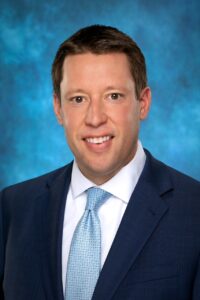
President, MercyOne Eastern Division, Davenport
The health care industry faces significant challenges driven by limited access to care, workforce shortages, rising demand, and capacity constraints. MercyOne Genesis is addressing these through strategic investments and partnerships that expand services.
Access to women’s health care and the delivery of high-quality obstetric care remain critical priorities. MercyOne Genesis has responded as a market leader in the Quad Cities with a 194% increase in deliveries at our Silvis campus, guided by Dr. Yazeji May’s vision for comprehensive women’s health care.
The growth in 2025 at our Silvis campus was supported on multiple fronts. In June, Medical Arts OB/GYN physicians Dr. Justin Hinzman, Dr. Karla Van Keulen and Dr. Rhonda Freed relocated to the Larson Center on the Silvis campus.
The Silvis Birth Center also launched a Neonatal Nurse Practitioner Inpatient Program in 2025, in which a nurse practitioner is available around the clock to care for newborns in our Level 2 Nursery. In addition, the MercyOne Genesis OB/GYN Group in partnership with The Group delivers nearly 3,000 OB deliveries annually.
With Emergency Department crowding and rising patient acuity challenging health care systems nationwide, MercyOne Genesis expanded the Bettendorf Emergency Department to 16 beds, improving patient flow, reducing wait times, and strengthening emergency access.
Primary care shortages and the need for chronic disease management are intensifying. MercyOne Genesis invested in the Davenport Health Plaza, expanding internal medicine services with 13 additional exam rooms. In Eldridge, we are opening nearly 8,000 square feet of new clinic space to serve 10,000 patients.
Together, these initiatives demonstrate how MercyOne Genesis is proactively confronting health care’s most pressing issues by expanding access, increasing capacity, and strengthening community-based care.
MANUFACTURING
Find the signal by lowering the noise in 2026

President/CEO, ALM Positioners, Rock Island
As we move into 2026, I thought I would share this simple formula. What does the signal to noise ratio have to do with business climate?
Every day we are exposed to business media, social media, and many other forms of instant information. Our current landscape drowns us in data, smothering our ability to find clarity. Every day, we are bombarded by a never-ending stream of market volatility reports, industry trends, and speculative headlines.
As leaders, our instinct, when faced with this noise, is to increase our search for clarity; we dig in, drill down, turn up the volume, and listen for evidence to help shape our thesis. However, in the world of communication theory, simply increasing the inputs does not improve the Signal-to-Noise Ratio (SNR); it often just creates more static.
Effective leadership means reducing noise rather than just listening through it. The “Signal”‘ in business isn’t typically found in the 24-hour news cycle or the latest social media trend. It resides in the needs, challenges, and successes of our customers.
If we spend less time listening to the external static, and focus on that core signal, the path forward becomes remarkably clear. Our job is to be the filter for our organizations, shielding our teams from the distraction of the “noise” so they can focus on delivering genuine value.
If we all commit to lowering the background noise, and focus on proactive management, good things will happen. A high SNR isn’t just a technical achievement; it is a business imperative. In 2026, let’s be intentional about minimizing the noise, and let’s refocus on the critical signal: Our customers’ success.