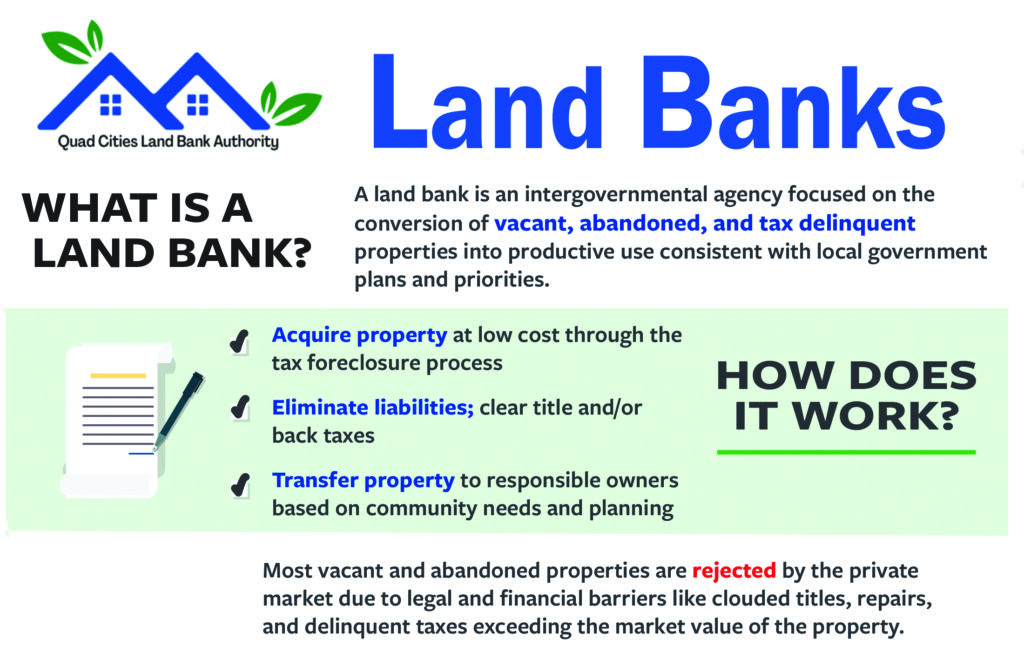
Since 2022 the Quad Cities Land Bank Authority has been working to attack zombie structures in Moline and East Moline and reclaim Rock Island abandoned properties so they can one day be returned to each city’s tax rolls.
Now with a three-year seed-funding commitment by the municipalities that created Illinois’ ninth land bank set to expire at the end of the year, the QCLBA governing board is exploring new funding formulas to advance its mission to buy vacant, deteriorating and delinquent properties and get them in the hands of new owners.
“The land bank has been slow to start, but it isn’t going anywhere,” promised QCLBA Board Chairman Miles Brainard. “We are committed to finding some workable model” for a successful future, the City of Rock Island community and economic development director and the longest-serving land bank board member recently told the QCBJ.
Once the land bank launched with the support of the Illinois Housing Development Authority (IHDA) in April 2022 it has been backed by an annual population-based financial contribution from its three member cities – Rock Island, Moline, and East Moline – of about $1 per person per city. A $268,000 IHDA Strong Communities Program grant also later allowed for the demolition of the five zombie structures in East Moline, and the eventual purchase of the 10 properties in Rock Island.
In September 2022, the land bank hired Program Manager Mary Chappell and put her considerable skills and deep planning and development experience – including with the City of Rock Island – to work on ridding the region of blighted homes, garages, sheds and more.
Such properties are often called “zombie structures” because they hang around without serving any good purpose and continue to decay, much like the living dead in scores of movies of that genre.
Ms. Chappell told the QCBJ that current efforts by the land bank board and staff to research and consider new funding options that will carry that work into FY2026 and beyond is timely because member cities also are engaged in their own budget processes.
As the land bank works on a new formula, it will continue to seek grants and opportunities to support programs and overhead because, she said, “the need remains great and there is much work yet to be done.”

Taste of the possible
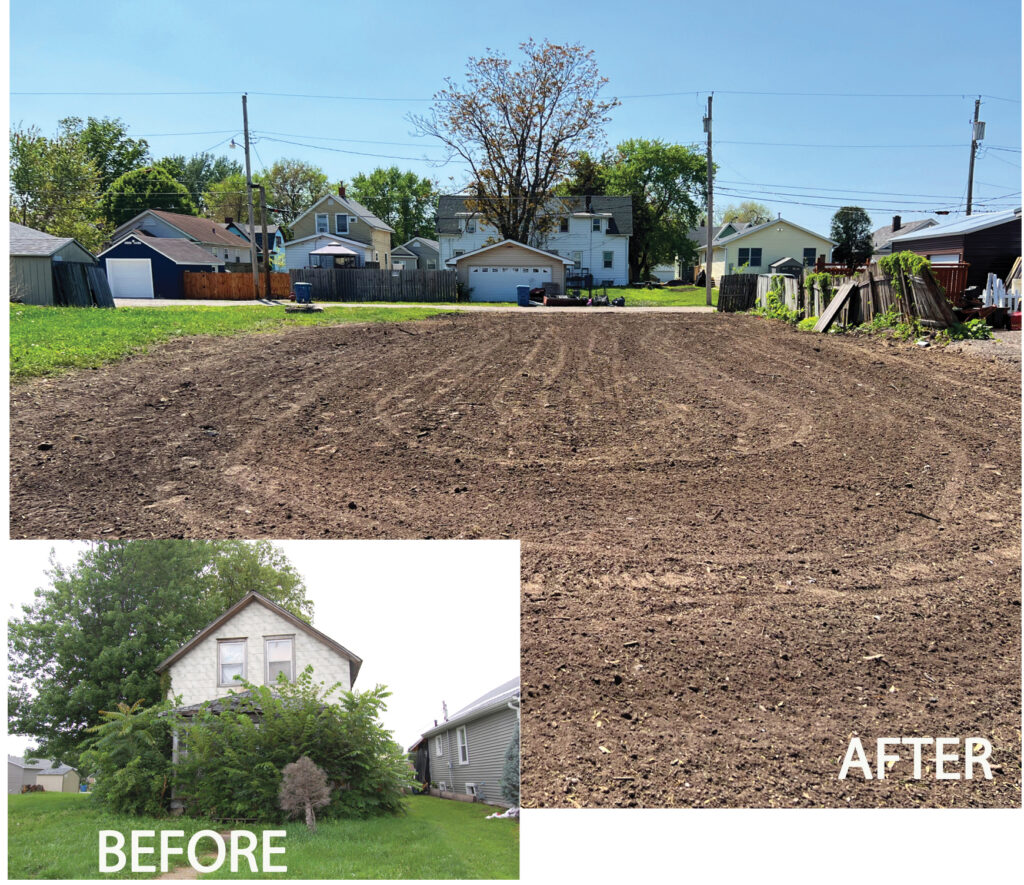
Meanwhile, the land bank’s recent tangible accomplishments provide a taste of what’s possible. For example, it has secured ownership and demolished five long-time deteriorating structures in East Moline and made the sites ready for purchase and development. (Find a listing of the inventory at qclba.org.)
Those transformations are critical to cities’ financial wellbeing as unpaid property taxes pile up and the costs of grass cutting and maintenance climb. Not only is taking control of abandoned structures costly, they must be boarded up until they are demolished. Razing them costs many thousands of dollars depending on the building’s size and the problems found at the cleared site. Land banks can absorb those costs.
Neighbors also pay through decreased property values, higher insurance premiums, fire and safety hazards, neighborhood population declines, weakened sense of community and a reduced quality of life, the QCLBA said.
By contrast, the sale of problem properties breathes new life into old neighborhoods by freeing them from the unsightly structures where oftentimes dangerous bad actors and multiple litters of cats routinely take refuge, Ms. Chappell said.
Once the land bank gets control of the properties, they can either be sold to single-family owners or housing developers, while smaller parcels are offered for purchase as side lots to adjacent homeowners. Commercial properties are sold as-is to buyers to spark economic development and job creation.
That’s the plan in Rock Island as the land bank continues to work to acquire 10 abandoned residential properties there so they can be sold to vetted investors who are committed to their productive reuse and returning them to the property tax rolls, Ms. Chappell said.
Slowing that work and making the search for new funding more imperative is the 2023 U.S. Supreme Court Tyler vs. Hennepin County, Minnesota, ruling. It addressed the constitutionality of local governments keeping surplus revenue from tax foreclosure sales.
Essentially, Mr. Brainard said the high court established “the pre-existing system in most counties around the country where local municipalities might be able to get what I would call ‘first dibs’ on tax auction properties or properties that have been taken for nonpayment of taxes could no longer continue.”
Mr. Brainard said the majority opinion “dramatically altered” the ability of land banks “to take control of abandoned properties that were not too far gone before they went through the auction process and then, in alignment with different community plans, pass them strategically into other people’s hands.”
The ownership of such properties directly impacts cities’ ability to take back their neighborhoods. “We have to take power back from these exploitative fly-by-night investor types who are not here, and who don’t care about our community,” Mr. Brainard said.
“They just want to get whatever money out of it they can by abusing vacant and abandoned properties and the tax sale process. We want to make sure that we are keeping money here, helping folks invest in their own towns, their own neighborhoods.”
Hungry locals encouraged
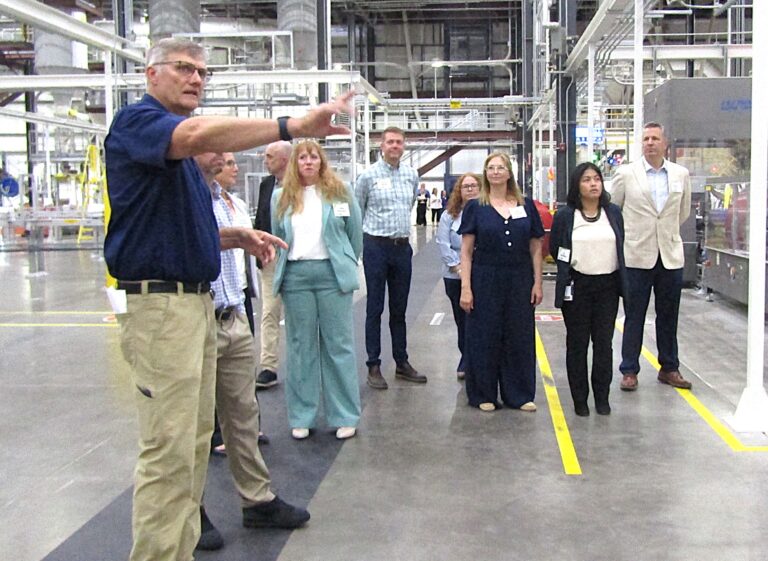
To help educate local investors, the QCLBA held its first “Vacant Spaces to Vibrant Places” Opportunity Workshop. It already is planning to repeat the March 19 workshop that was attended by 45 people including home fixer-uppers and 14 local contractors.
A big takeaway from the session was: Bring your ideas because when it comes to housing the doors are wide open. Ms. Chappell said. In addition to traditional houses, for example, other concepts that are being explored locally include infill housing, prefab homes, container homes and tiny homes.
Ms. Chappell urges first-time developers not to be intimidated by the development process because the land bank can find experts who will help them along the way.
At the initial workshop an IMEG engineer put together several concepts to show what a housing development might look like and what is feasible and when. That’s invaluable for developers when they reach out to their banker for financing.
“Who do I want to work with?” Mr. Brainard asked. “The hungry young, ambitious people here in the community who care about the community and want to invest in it, the folks who showed up at our workshop, many of them were smaller time contractors and business people who live here and want this place to be better, and they reasonably want to expand their business portfolio.”
Another advantage of land banks is their home rule powers, Ms. Chappell said. For example, in East Moline – where voters have regularly rejected efforts to adopt home rule – the QCLBA allows the city to borrow that home rule authority to clear titles and do other work that would not have been possible without it.
The same could be true for other smaller area cities and Rock Island County, if they elect to join the QC land bank. Ms. Chappell also is interested in working with Iowa Quad Cities neighboring governments. To learn more, contact Ms. Chappell at (309) 524-2043 or [email protected]
As the QC land bank seeks to expand, elsewhere in Western Illinois another group is developing Illinois’ 10th land bank. The fledgling Prairie Hills Land Bank Authority’s goal is to get rid of abandoned buildings and support single-family housing development in an area that includes Mercer and Henry counties in the Quad Cities area.
More lofty aspirations
Also going forward, Mr. Brainard said “one of my aspirations, and it’s pretty lofty, is to create an Illinois Land Bank Association.”
It would allow land banks across Illinois to advocate “not just for our own budgets getting support, but for the things we’re trying to fight against.” That includes, he said, an existing tax auction and tax sale process that favors rich absentee investors.
“It’s a statewide issue that requires a statewide response,” he added.
“The way in which investors far afield can exploit the system and extract wealth from our communities is extraordinary and deeply upsetting,” Mr. Brainard said. “The idea that people from the coast or from Texas or wherever, are able to buy blocks of abandoned properties in investment bundles and they don’t even know or care what actually is in it.”
Then, he said, they “sell off the 80% that are of some kind of value and then just abandon the rest and gradually, just grind down our housing stock into nothing.”
They also stick the community with the bill for mowing yards and tearing houses down when they’re not salvageable anymore.
A statewide association also could help address the absence of significant and direct Illinois state government investment in land banks and the work they do.
While IHDA’s initial contributions to the QCLBA were welcome as was a second grant it later awarded, to date Illinois has directly invested in just three large land banks including one in Cook County. And they received funding only after exhaustive lobbying, Mr. Brainard said.
The price of not investing is substantial.
“The majority of your built environment is housing, and housing is the baseline of community,” he said. “Families move in there and put more kids in the schools. If they can’t find good quality housing that meets their needs, you can’t find employees to come work at your business.”
That means, he added, “If they can’t find housing that meets their needs, you’re not going to find that people want to stay in your community as they transition out of the workforce. If they can’t find housing that meets their needs, it intersects with all these different issues.”
LAND BANK AT A GLANCE
- Formed in April 2022.
- hired Program Manager Mary Chappell in September 2022.
- Properties in inventory – 6.
- Properties under management – 7.
- March 2025 workshop attendees – 45, including 14 local contractors.
- Website: www.qclba.org
Source: Quad Cities Land Bank Authority