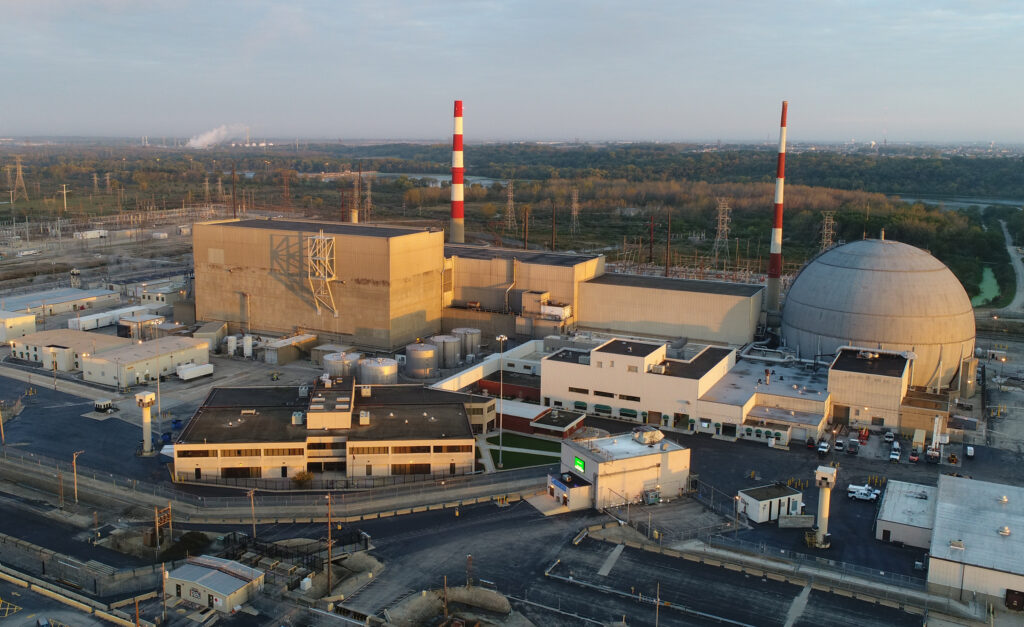
The Nuclear Regulatory Commission (NRC) has approved license renewals for two of Constellation’s Illinois nuclear plants, the Warrenville, Illinois-based energy provider announced Tuesday, Dec. 16.
Constellation said in a news release that the NRC approved a 20-year initial license renewal for its Clinton Clean Energy Center and a 20-year subsequent license renewal for its Dresden Clean Energy Center. The approvals allow Clinton to operate through 2047 and the Dresden reactors to operate through 2049 and 2051.
The action followed a rigorous review by the NRC of maintenance activities, plant equipment and safety systems at the two Illinois facilities.
Constellation also is the operator of the Quad Cities Clean Energy Center in Cordova, Illinois, formerly known as its Quad Cities Generating Station. The Quad Cities reactors are licensed to operate until Dec. 14, 2032, the company told the QCBJ.
The company is the nation’s largest operator of clean, reliable nuclear power. In the release, Constellation also said it is investing more than $370 million to relicense the plants including the installation of state-of-the-art upgrades to increase efficiency and ensure safety and reliability.
“In the last ten years, we’ve invested over $3 billion in our high-performing Illinois nuclear facilities to power the state’s economy with clean, reliable energy,” Bryan Hanson, Constellation executive vice president and chief generation officer, said in the release.
“These license extensions will allow Clinton and Dresden to stay online for another two decades, preserving more than 2,200 family-sustaining jobs and $8.1 billion in federal, state and local tax dollars,” Mr. Hanson added.
The NRC’s approval also was called “a win for workers, communities, and Illinois’ clean energy future,” by Sean McGarvey, president of North America’s Building Trades Union (NABTU).
“By renewing the operating licenses for the Clinton and Dresden clean energy centers, Constellation is ensuring decades of good union jobs while delivering reliable, carbon-free power,” he said in the Constellation release. “Our highly skilled members are proud to operate and maintain these plants safely every day.”
Plant upgrades
Mr. McGarvey added that NABTU, the International Brotherhood of Electrical Workers (IBEW) and other affiliates “value this long-term commitment, which demonstrates the success of labor and industry working together effectively to deliver the energy solutions our nation needs.”
According to Constellation, its Clinton plant has two new auxiliary transformers and two advanced equipment chillers that are delivering higher system reliability. In addition, upgrades to the plant’s condensate polisher system offer greater protection from component degradation.
At Dresden, operators are now using next-generation feedwater level control technology to enhance reactor safety, while a new main power transformer purchased for the plant will deliver state-of-the art electrical system monitoring and control.
While these license renewals give Constellation the regulatory approval needed to operate Clinton and Dresden for another two decades, actual operation is contingent on each plant’s financial viability, it said in the release.
At Clinton, the facility’s carbon-free energy is secure as a result of the 20-year agreement with Meta announced in August. The deal supports the continued operation, expansion and relicensing of the 1,121-megawatt Clinton facility following the expiration of the state’s Zero Emission Credit (ZEC) program in May 2027.