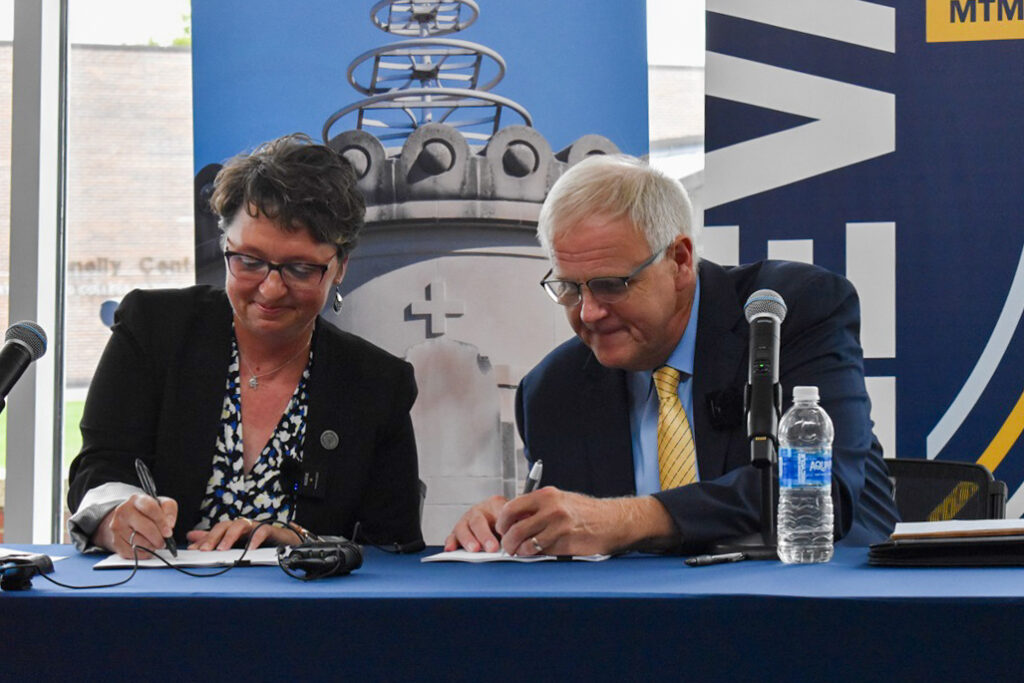
Over the past year, St. Ambrose University and Mount Mercy University have been engaged in one of the most consequential higher education integration efforts underway in the Midwest. While public attention is often drawn to mergers only at moments of final approval, the more important and more instructive story lies in the disciplined mission-driven work taking place during the integration itself.
That work is well underway.
As expected in a transaction of this complexity, our progress with the U.S. Department of Education has experienced a modest slowdown. These regulatory processes are intentionally thorough, and while the timeline has extended beyond our original projections, the pause has not slowed the substance of our work. Instead, it has allowed both institutions to deepen collaboration, test shared systems, and build the academic and operational foundation needed for long-term success.
Nowhere is this more evident than in the development of a more robust and focused core curriculum and the development of integrated majors and course offerings.
Faculty from both campuses have worked intensively to design a shared core that is deeply rooted in the Catholic intellectual tradition while also being explicitly relevant to today’s business and industry needs. This curriculum emphasizes critical thinking, ethical reasoning, communication, data literacy, intercultural competence, and adaptability. These are the skills and dispositions employers consistently tell us they need, not only now but for a rapidly changing future workforce. The result is a curriculum that prepares graduates not simply for their first job, but for meaningful careers marked by leadership, integrity, and service.
At the same time, we are expanding and strengthening graduate and professional programs across both institutions. Guided by market demand and regional workforce needs, we are looking forward to advancing new offerings and refining existing programs in healthcare, business, education, information technology, science and emerging interdisciplinary fields. This work reflects a disciplined approach to growth that focuses on building programs where there is demonstrated need, academic excellence, and a clear return on investment for students and for the region.
Importantly, these academic advances are occurring alongside tangible progress in enrollment. Mount Mercy experienced its strongest freshman class in history and St. Ambrose was up 14% over last year. This momentum reflects renewed clarity in academic offerings, improved coordination in recruitment and advising, and growing confidence among students and families that this integrated university model offers both stability and opportunity.
Operationally, the integration is delivering on its promises.
Key performance indicators related to shared services and back-office consolidation are being met. Cost savings identified in finance, human resources, information technology, and procurement are materializing as planned, allowing us to reinvest resources into academic quality, student support, and strategic growth. These efficiencies are not about doing less. They are about being smarter by reducing duplication while preserving the local identity and strengths of each campus.
Equally significant, though less visible, is the progress in shared governance. Faculty leaders from both institutions have undertaken the complex and often challenging work of rewriting a unified faculty constitution. This effort reflects deep respect for shared governance and a desire to build a sustainable model of governance inclusive of both campuses. It is also a powerful sign of trust and a willingness to shape a common future while honoring the histories that brought us here.
Looking ahead, this integration is not an end in itself. It is the foundation for something larger, the development of a Catholic College/University Network. This emerging network model envisions Catholic institutions working together to share services, align academic strengths, and amplify mission while maintaining local presence and identity. In an era of demographic shifts and financial pressure across higher education, collaboration rather than isolation will define which institutions thrive.
For employers and economic development leaders across the Quad Cities and eastern Iowa, this work has direct and practical implications. A stronger and more aligned Catholic university means a more predictable and better prepared talent pipeline, graduates who understand both technical competence and ethical responsibility, and institutions that are increasingly nimble in responding to workforce needs. As industries evolve, our students are being educated not only to fill jobs, but to lead teams, navigate complexity, and contribute meaningfully to the civic and economic life of the region.
This integration also strengthens our capacity as anchor institutions. By reducing duplication, aligning programs, and investing savings back into academic quality and student success, we are building universities that can be long-term partners to business, health care systems, school districts, and nonprofit organizations. That stability matters to employers making multi-year investments and to communities seeking sustained economic growth rather than short-term solutions.
Integration is rarely simple. It requires patience, discipline, and an unwavering focus on mission. But the progress at St. Ambrose and Mount Mercy demonstrates that when institutions lead with mission, clarity and collaboration, integration can be a catalyst for regional competitiveness. Our commitment is clear. We will continue to educate graduates who are prepared for today’s workforce, adaptable for tomorrow’s economy, and grounded in values that strengthen not only organizations, but the communities they serve.
Amy Novak is the president of St. Ambrose University in Davenport.
Todd Olson is the president of Mount Mercy University in Cedar Rapids.