Thanks to the work of skilled Quad Cities tradespeople who completed the $18 million Phase 1 of the Quad Cities International Airport’s ambitious Project Gateway modernization, travelers are zipping through QCIA faster and easier than ever before.
Passengers have benefited since Friday, April 4, for example, from a new fully operational baggage makeup building along with streamlined ticketing counters. Airline counters also are easier to find, now that they are in their new permanent location following Phase 1 disruptions, QCIA’s Public Relations and Marketing Director Ashleigh Davis told the QCBJ.
For accessibility and convenience sake, repack scales have been added on either side of those ticketing counters. “For bags over 50 pounds this allows you to place individual items on the scale to get under weight,” Ms. Davis said.
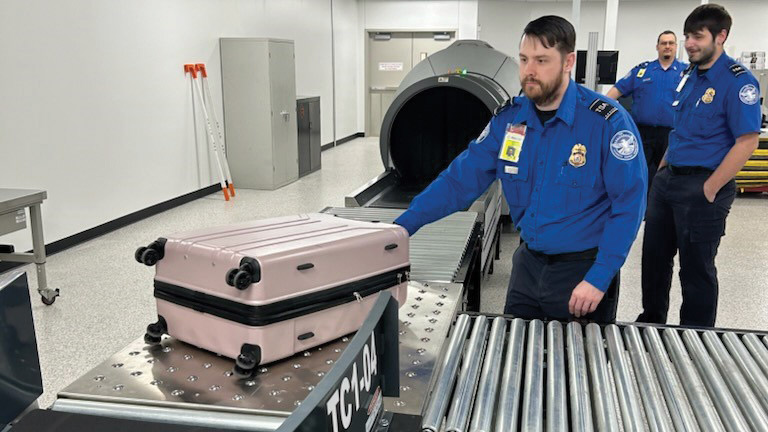
Critical, too, to accessibility and convenience is the gleaming white 14,600-square-foot secure baggage handling area – featuring a state-of-the-art conveyor belt system – that the airport first unveiled on Monday, March 31.
That building’s Friday, April 4, startup came exactly one year after Phase 1 construction launched in 2024. It allows Transportation Safety Administration (TSA) agents to safely process luggage away from the eyes of the public and it also will mean travelers no longer will have to haul heavy bags through screening.
QCIA passengers also are enjoying a smoother check-in experience thanks to the upgraded ticketing counters installed as part of the first forward-facing upgrade to the Moline airport in 40 years.
Last month’s Phase 1 ribbon-cutting also allowed QCIA Executive Director Benjamin Leischner to sketch the timeline for Project Gateway’s $20 million Phase 2.
“While today is about celebrating how far we’ve come, it’s also about looking ahead,” Mr. Leischner told a large group of community and project leaders, many of them representing the Quad Cities tradespeople who made Phase 1 possible. Phase 2 is set to begin in the fall of 2025, with design work expected to be completed in July, the airport leader added.
A QC ‘game-changer’
U.S. Rep. Eric Sorenson, D-Moline, a frequent QCIA flyer, was among those lauding the renovation. “We’re making travel through the Quad Cities more efficient, more secure and more welcoming. I can’t wait to use this myself.”
Travelers aren’t the only ones who will benefit, however.
“A strong airport means a strong economy,” Mr. Sorensen added. “It means more jobs, more opportunities and a more connected community, whether it’s families heading out on a vacation, business travelers bringing new investment into our region or service members flying to and from their active duty.”
Mr. Leischner called Phase 1’s completion “another exciting milestone” in the multi-million-dollar, multi-year transformative Project Gateway journey taking place at QCIA.
“When we first announced this project on this day four years ago, COVID was still dominating our day-to-day lives and we had no idea what to expect month-to-month, let alone the years it would take to begin executing this plan,” he said.
“Our vision and promise was that we would modernize and enhance the passenger experience in ways that would reflect the growth, innovation and vitality of the Quad Cities region,” Mr. Leischner added.
He singled out QCIA’s design partner Alliance for helping “establish an authentic sense of place that will guide future design phases and will help make sure that our airport is quintessentially Quad Cites.” And he saluted Randy Clarahan, the market executive for Mortenson who is leading the Project Gateway effort. Mr. Clarahan, in turn, applauded airport leaders, the QC Mortensen team and Quad Cities trades and suppliers who brought Phase 1 to life.
“When we were selected back in November of 2021 – seems like a while ago – in the interview I remember distinctly we made promises and commitments that said we would deliver this project safely, on budget, on time and those promises were met and I think exceeded in some ways,” Mr. Clarahan said.
Keeping dollars in QC
He also promised then “to make sure that this project was going to be built locally, with local subs and local craft labor.” Mortensen, with offices in Iowa City, delivered on that score given that of the 15 total subcontractors and suppliers on the project, 11 were from the Quad Cities area and just two were from outside Iowa and Illinois.
Mr. Leischner added “We’re incredibly fortunate to have robust skilled trades in our region to allow us to keep federal funding in our community and reinvest it into local jobs, amplifying federal investment, six to seven times over its initial direct impact.”
First-tier regional subcontractors and suppliers for Phase 1 included: Builders Sales and Service, Bush Construction, Allied Construction Services, Continental Fire, Economy Roofing, Gagnon, L&L Flooring, Lovewell Fence, Northwest Mechanical, Raynor, Treiber Concrete, Tri-City Electric and Tri-City Iron Works, according to Mortenson. Additional second-tier suppliers and contractors also played a role.
“The partnerships that we had across the board were outstanding,” Mr. Clarahan said. “A shoutout to AJ Loss and the Bush team who were integral in helping us get that done.”
In all, Mr. Clarahan said “Over 96% of the craft labor was from here, from the Quad Cities, and we’re proud to continue to work with them as we continue to look forward to celebrating today but then looking forward to the next phase of the project which is going to be more public-facing.”
What’s next?
Those upcoming improvements will, for example, include adding a curbside canopy for weather protection, updating restrooms to include companion-care facilities and nursing rooms, relocating public meeting spaces for better accessibility and creating an indoor/outdoor observation area for travelers and visitors.
Importantly, too, the modernization will involve removing the old, brown brick tile flooring that covers the terminal’s public-facing floors and replacing it with new more modern flooring.
Many QCIA travelers who have dragged clickety-clacking bags across the bumping surface are no doubt celebrating the impending removal and replacement of the dated flooring covering. Other locals, however, may miss it.
“We know it’s nostalgic for many,” Ms. Davis said of the flooring. “But for wheelchair users, or people using other mobility devices, it is challenging terrain so it’s time to go.”
Replacing the old tile that currently dominates the airport terminal landscape also highlights the importance of this ongoing airport modernization.
“This airport connects families, fuels our region’s economy and welcomes visitors from all over the world,” Mr. Leischner said. “It should be a reflection of the Quad Cities, a place of innovation, warmth and progress.”
In celebrating the Phase 1 completion, Mr. Leischner also thanked Jennifer Radloff, chair of the Metropolitan Airport Authority of Rock Island County, whose expertise as a project manager for Shive-Hattery was invaluable. She said the March 31 celebration was more than a ribbon cutting. “It’s a testament to our community’s commitment to progress.”
“The airport is our airport. It connects families. It fuels our economy and it welcomes visitors from around the world,” Ms. Radloff said. “It should be a point of pride, setting the tone for the experiences people have while they’re here and offering a sense of home when they return.”
She added: “While there is much more to come – getting rid of the brown brick floors – the completion of this phase is a critical step forward. Every phase, every improvement brings us closer to realizing the full potential of this transformation.”
Phase 1 – By the Numbers
- Precast Panels: 144 yards of concrete used to fabricate structural pre-cast concrete walls.
- Radiant floor heat: 17,500 linear feet of tubing embedded in concrete; 250 gallons of glycol used as a heating solution.
- Demolition: More than 3 million pounds of concrete removed from site.
- Structural steel: 31 tons of structural steel installed.
- Subcontractors and economic impact: 15 total subcontractors/suppliers on the project. In all, 11 were from the Quad Cities area and two from outside Iowa and Illinois.
- Total subcontract value: $9,022,893. And $6,460,094 of it went to local area contractors and suppliers.
- Labor Hours: 26,316 labor hours have been performed on the project, all skilled trades. A total of 25,445 hours were performed by Quad-Cities area trades.
- Funding: Combination of Federal Aviation Administration (FAA) airport entitlement funds and U.S. Bipartisan Infrastructure Law (BIL) funding. QCIA allocated $2.8 million per year for five years through BIL, helping to cover a majority of the $18 million cost of this phase without increasing airline rates and charges.
Source: Quad Cities International Airport