The U.S. economy is likely to see some economic growth next year and the Quad Cities region could see a slightly stronger year for businesses in 2026, a pair of economists told business leaders at the Quad Cities Chamber annual Economic Forecast.
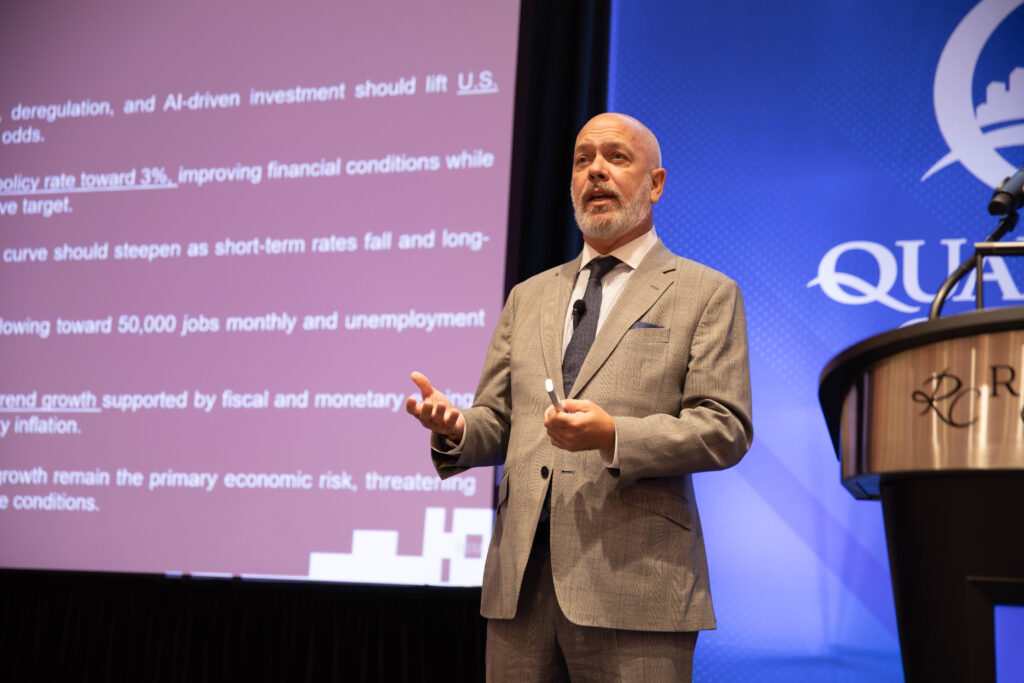
The Friday, Dec. 5, chamber event at Rhythm City Casino Resort in Davenport was headlined again this year by RSM Deputy Chief Economist Kevin Depew.
He, along with Bill Polley, Grow Quad Cities senior director of business intelligence, provided chamber members and guests with what the chamber called “a grounded outlook on growth, inflation, labor markets and the risks that could shape business planning in 2026.”
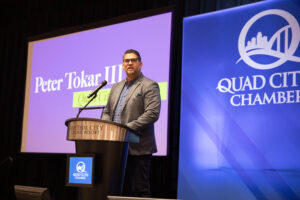
Before introducing the experts Friday morning, Quad Cities Chamber President & CEO Peter Tokar III also updated chamber members about the Grow Quad Cities economic development arm Mr. Tokar also leads.
That organization is designed to take a comprehensive approach to development of the region’s economy, image, strength and competitiveness, Mr. Tokar told a packed house at the chamber’s Aug. 6 annual meeting.
Four months later, Mr. Tokar said that partnership has “boiled” that longer description “down into something simpler” to quickly tell the story of the value of an organization he said provides through three key pillars of service. They are: “Be Seen, Be Heard, Be Profitable.”
Among the ways the chamber does that he said is by hosting events such as the economic forecast, maintaining a member portal to provide local businesses with information and resources. Importantly, too, it shares information about the region’s businesses, amenities and advantages with potential developers and customers on a website that records 16,500 visits a month.
Chamber ‘a megaphone’
“This is the chamber serving not as the voice of the community, but a megaphone,” Mr. Tokar said. It includes legislative trips to Washington, D.C; Springfield, Illinois; and Des Moines to support measures that are good for the region.
He introduced Mr. Depew who shared with those members a “cautiously optimistic” 2026 U.S. economic forecast that he suggests could include 2.2% growth in the nation’s GDP next year.
At the same time, Mr. Depew said U.S. jobs are expected to continue slowing down and unemployment may climb slightly to 4.5% as companies adjust to lower staffing levels. Still, his 2026 offers a 45% chance that the economy will grow a little faster than it had in 2025 in part due to easier fiscal and monetary policy.
At the same time, however, Mr. Depew said “We still are forecasting this year for inflation to be above 3% versus above the Federal Reserve’s 2% preferred target.” That 3% figure also appears to have been adopted, at least quietly, by the Fed, he added. In addition, a moderating labor market, low unemployment overall and affordability pressures, could impact that number. That’s also why analysts are closely watching who will be selected as the new Fed chairman when Jerome Powell leaves the board of governors in May 2026.
For now, Mr. Depew said RSM is anticipating two more interest rate cuts by the end of the year.
Key areas to watch in 2026 include affordability challenges and slower real wage growth that remain concerns for some households.
Mr. Depew acknowledged, for example, that lower-income Americans continue to lag behind economically due to that ongoing affordability crisis. “It’s impacting many millions of households,” he said. “Inflation is a problem. Interest rates are a problem.”
Transitioning economy
At the same time, he added, “the Fed has done a great job of reducing the inflation problem. We have real wage gains.” Such gains show he said that “you can have multiple competing truths” in a continually transitioning economy that is also being impacted by “accelerating technology” led by artificial intelligence (AI).
Other areas worth watching in 2026 are ongoing trade deal discussions between the U.S. and China and other nations and the potential for an end of the war between Ukraine and Russia, Mr. Depew said. Those international developments and any cease in armed conflict would have a significant impact on the manufacturing-heavy Quad Cities.
“Both China and the U.S. have incentives to work together rather than continuing to isolate ourselves into blocks,” Mr. DePew said. Such a deal in addition to stimulus tax cuts and lower regulations, and a productivity boost related to AI would help overcome the economic losses due to the longest federal shutdown on record that came in the current quarter.
“So 2025 is not going to look great” by year’s end, he said, and some of that impact may linger into the first quarter of 2026.
Mr. Depew also pointed to the potential economic impact of the Supreme Court ruling on the Trump administration’s blanket authorization for tariffs. “If the Supreme Court does decide to overturn the emergency authorization, you’ll start to see upward pressure on rates, which makes the fiscal trajectory a little worse,” he said.
“The shutdown is going to subtract some growth from the current quarter, so “2025 is not going to look great,” but that could be offset in January with the new tax bill and lower regulations, Mr. Depew added.
QC eyes slower growth
That’s also true in the Quad Cities, where Mr. Polley said businesses are watching trade deals which could alleviate some of the concerns of the large and small companies that trade internationally.
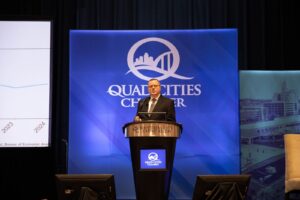
Mr. Polley said factors affecting the region vary a bit from the rest of the country because the six-county metropolitan statistical area is 66th out of 380 metro areas in the U.S.
He shared the latest QC Chamber Quarterly Market Report survey that showed 61% of respondents believe tariffs had a negative effect on their businesses, with 35% saying they altered business decisions this year because of tariffs.
“I think what’s going to happen over the next few months is that more of those trade deals are going to start happening,” Mr. Polley predicted. “That starts to resolve some of the uncertainty and really helps the firms here in the QC that are so involved in international trade. As long as we don’t have any more disruption, I think that really helps us.”
Also worth watching is whether new, more aggressive Federal Reserve monetary policy in the new year will strengthen the dollar, thus negatively impacting exporters. Then there is how the Supreme Court’s emergency authorization for terrorists ruling will impact affect immigration policies and interest rates.
As a result of those challenges, Mr. Polley told the crowd his 2026 forecast is more conservative than Mr. DePew’s national view.
“I think we end up with a year above zero for growth” pending the downside risk if the U.S. GDP falls lower than expected, Mr. Polley said of the Quad Cities.
(To track the impact of policies on the regional economy, follow Mr. Polley’s market reports here.)