Davenport Works, the sprawling John Deere heavy equipment factory the company calls a “smart, connected manufacturing system,” is being honored this month as Assembly magazine’s 2025 Plant of the Year.
That massive technologically advanced plant at 1175 E. 90th St., Davenport, is led by Factory Manager Tom Johnson. He said the timing of the Assembly award and the in-depth story about Davenport Works by its Senior Editor Austin Weber is fitting because it was published on National Manufacturing Day, Friday, Oct. 3.
That annual observance, held on the first Friday in October, is part of Manufacturing Month and was created to encourage opening the doors of manufacturers to students, parents, and community leaders.
Mr. Johnson also shared with the Quad Cities Regional Business Journal an insider’s look at some of the big leaps the award-winning Davenport Works is making and the importance of the Plant of the Year honor in an exclusive interview recently.
“Whether it’s planting soybeans in Illinois, building roads in Brazil, harvesting wheat in Ireland, logging trees in British Columbia or shoveling iron ore in Australia, John Deere is known for building reliable off-highway machinery,” Mr. Weber, the story’s author, wrote in the monthly manufacturing trade magazine’s latest issue. “Indeed, farmers and contractors around the world know that ‘Nothing runs like a Deere.’”
That’s due to John Deere’s “legendary reliability” including at Davenport Works which, the magazine said, was selected for its 22nd Plant of the Year award “because of its innovative use of plant floor technology and Deere’s commitment to expanding its American manufacturing.”
A Davenport Work’s employee applies the John Deere decal to one of the big Deere yellow machines made at the plant at 1175 E. 90th St., Davenport. CREDIT DEERE & CO.
That includes the $20 billion investment the Moline-based global manufacturer is making at its U.S. operations. Of that, Deere is invwesting more than $250 million in the Quad Cities at East Moline Harvester Works, John Deere Seeding in Moline and Davenport Works. In all about $75 million will modernize processes and bring advanced construction and forestry products to market at the Davenport operation.
That plant’s path to Plant of the Year honors was sparked by a tour Mr. Weber took at Davenport Works along with a group of technology journalists. He later requested a second visit which ultimately resulted in the Assembly magazine award and helped inform his detailed piece celebrating the 51-year-old Deere factory.
Growth is exponential
The plant was originally built in 1974 on 900 acres Deere bought on the north side of Interstate 80 in Davenport to give the company room for expansion of the crowded industrial equipment division located in Dubuque, Iowa. Today it has grown from a healthy 400,000 square feet to a 2.2 million-square-foot manufacturing behemoth.
That has allowed it to triple a product line that began with end loaders and excavators, and now includes four-wheel drive loaders (Production and Utility class), articulated dump trucks, motor graders, skidders and wheeled feller bunchers.
The biggest piece of equipment built at Davenport is the massive 944 X-Tier wheel loader which, Mr. Weber wrote, stands 13 feet tall and weighs nearly 125,000 pounds.
For years and despite its prominence along Interstate 80 and the size of its impact, Davenport Works was hiding in plain sight for many passersby. Some may have known it was there, Mr. Johnson said, but didn’t know what happened inside.
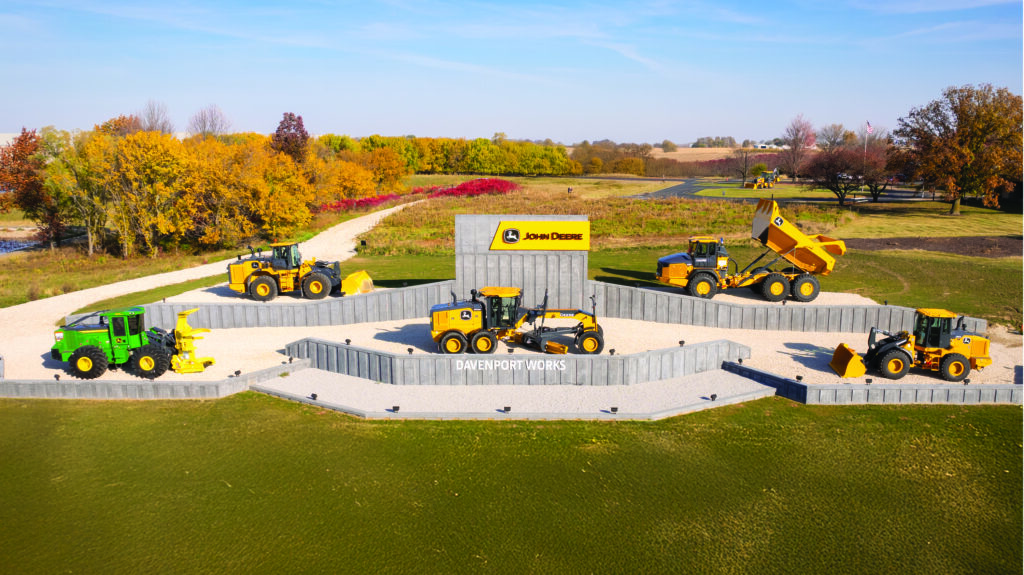
That prompted Deere to showcase the scale of its contributions by displaying some of the large advanced Deere Yellow construction and forestry equipment Davenport workers make.
In addition, the Plant of the Year Award not only will continue to raise the factory’s visibility, Mr. Johnson said, “It’s been fun to see the reactions from the team because I think a lot of people who come in the door every day kind of take for granted how talented they are, and how cool it is the work that they do.”
That includes Mr. Johnson who has had a 25-plus-year love affair with factories in general and now John Deere facilities in particular.
Though he manages the 2025 Plant of the Year, he’s quick to point out he doesn’t actually make the machines that roll off the line. It’s the 1,000 employees who come in the door every day.
And while technology is critical to making today’s machines, the work these employees do, for example, in welding, painting and assembly, is “still the core of what needs to happen in order to produce the vehicles that we produce,” he added.
Team members not only have traditional factory skill sets, he said they are “true craftspeople at what they do.”
Workers drive success
His own children, who range in age from 23 to 13, were impressed at first when they learned that the factory where dad worked made dump trucks. “But when they found out that I really don’t do the work, they were less impressed,” he joked.
“I think we just have a special place here at Davenport Works, and a lot of people that are really darn good at what they do, and it’s fun,” Mr. Johnson added. “It’s fun to give them some recognition.”
In truth, of course, Mr. Johnson has had a hand in the production of countless machines in a career at John Deere that began when as a student he dreamed of designing tractors one day. During his earliest experiences he quickly fell in love with factories, John Deere and the ever-evolving technology he was first introduced to there from drafting tables to 3D modeling software.
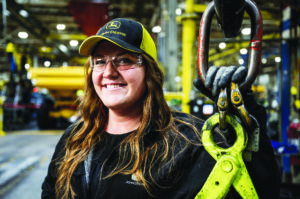
That ongoing evolution also helped make Deere one of the most technologically advanced companies in the world.
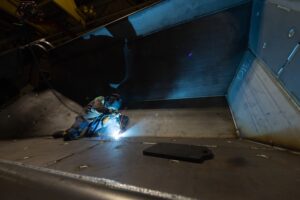
“The thing that stood out to me at Davenport Works, compared to all the other factories that I spent time at, is the size of the products and the type of the product” produced there by skilled employees, he said. Take, for example, welders who Mr. Johnson said “have to bring together just enormous pieces of steel and multiple passes of welding out of position.”
In addition to the Davenport Works team’s technological and traditional factory skill sets, workers are “curious; they’re competitive; and they want to continuously get better.”
It helps too, that “technology is pretty fun,” he added. “It can be frustrating, for sure, and we see that, and that’s where the experts help us out. But I would say the way that we’re thinking about technology is more of how we help some of the traditional jobs you think about in a factory be even better at doing their jobs.”
Among those advances are 5G connectivity which – unlike WiFi – allows workers, such as fork truck operators, to move through the factory while remaining in constant contact across millions of square feet and multiple buildings to ensure they can help operators get the parts they need.
Digital twinning also is essential for precision heavy equipment production. Mr. Johnson likened it on a much smaller scale to a digital representation of your home or living room that allows you to rearrange the furniture without physically doing the task.
“We have the same thing in our factory, so for all of the products that we make, all of the buildings that we have, both the outer building and the interior buildings, and the equipment inside the building, we have a 3D representation,” he said.
That’s important, Mr. Johnson added, because it costs millions of dollars to renovate an assembly line. With that technology “we can do some of that virtually or digitally before we move the parts around.”
Digital twinning also allows workers to “see” what equipment is being run in other areas of the factory. In addition, using Augmented Reality Davenport Works’ team of inspectors can catch problems in real time to ensure equipment is delivered to customers with all the bolts in place and the welds done correctly.
Size, technology matter
Size also matters in a factory that produces such mammoth equipment that even the smallest things it creates are large.
“I think that we deal with a lot of similar challenges that a lot of other factories do, but I think that the size of what we make adds a level of complexity, if you will, so that we just have to be conscious about safety,” Mr. Johnson said.
In fact, he said, safety is a critical part of Deere’s culture. Another is understanding that the “level of technology that we are now adding to the products just continually increases.” For example, he said there are more miles of wire on the products that Davenport Works is making than were on the first Space Shuttle.
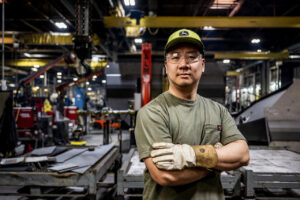
Nathan ‘Nate’ Anderson, factory level continuous improvement rep, poses for a photo at John Deere Davenport Works. CREDIT DEERE & CO.
“We’ve always been really, really strong at welding and assembling, but now we need to continually be really, really good at that, but also much, much better about how to route those wires so they stay connected,” he added.
In the past, much of the attention regarding connectivity and technology at Deere has been on the agriculture side, Mr. Johnson said, but “we’re talking much more now about precision construction as well.”
That includes expanded GPS which increases the safety of Deere’s heavy equipment for all the people working on a job site. “As does technology that helps the operator of the equipment to be aware of dangerous situations and even control the machine if there’s a risk,” he said.
Davenport Works also is using advanced technology on machinery such as motor graders. Among other things they are used to shape the ground before a new road is laid or to maintain existing gravel roads. Accuracy matters, Mr. Johnson said, “because if you get it right the first time, then a customer doesn’t have to come back and do it again, which costs more, (takes) more fuel, and now with GPS and some other technology, they can get the accuracy on that first pass of the road.”
Beyond technology, an essential part of what made Davenport Works No. 1 on Assembly magazine’s list is the plant’s One Davenport employee-focused culture.
“We talk about One Davenport a lot, and it’s one of those hard to replicate things,” Mr. Johnson said. He described it as the spirit that drives the plant’s culture and highlights a group of talented individuals who are “really good at their craft.”

He said, for example, “What’s cool about One Davenport is regardless of the position that they play on the team they know their purpose is to help the customers improve their business.”
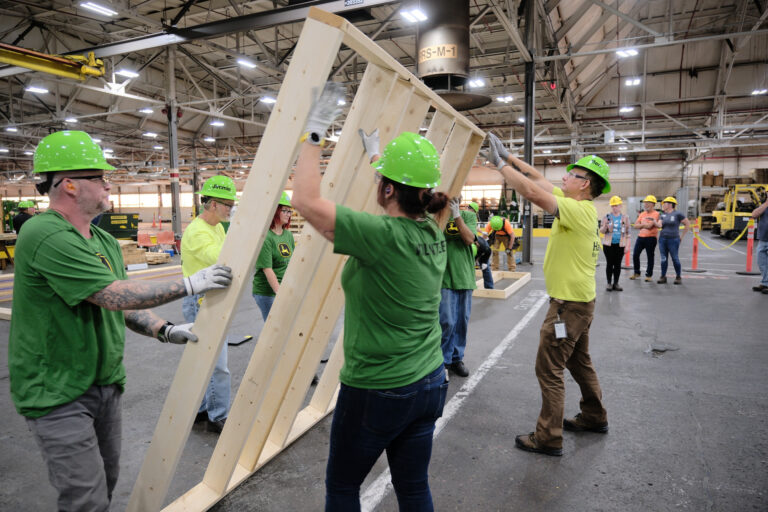
Also important are Day-in-the-Life sessions which bring together designers and production workers on the factory floor to talk about why they design the products the way they do and vice versa.
“I think it’s one thing to write it on a piece of paper and send an email and request,” but by doing it, he said, “they gain a different appreciation for the work that our design engineers do to make the products.”
John Deere Davenport Works
At A Glance
- Built in 1974, the factory employs about 1,000 workers.
- Between 120,000 to 125,000 is the operation weight in pounds of the largest pieces of equipment Davenport Works manufactures.
- It uses 45 million parts each year; more parts than the population of California in 2024.
- 33-foot cement walls surround the exterior of the 2.2 million-square-foot factory (equivalent to about 37 football fields).
- 200 tons of plate steel is cut each day, and more than 10,000 pounds of weld wire is used daily.
- 40,000 gallons of paint are used on equipment each year.
- Equipment built includes articulated dump trucks, four-wheel drive loaders, and motor graders for construction customers, and skidders and wheeled feller bunchers for forestry customers.
- Inspired by input from John Deere customers, Deere machines are designed for equipment owners and operators to boost productivity and uptime, while helping keep operating costs down.
- Innovative technology at the plant includes a 5G communications network that improves wireless connectivity and assembly line layout flexibility; state-of-the-art Industry 4.0 technology such as data analytics, digital twins, and smart fastening tools; and use of Automated Guided Vehicles and Autonomous Mobile Robots throughout the factory.
SOURCE: JOHN DEERE